
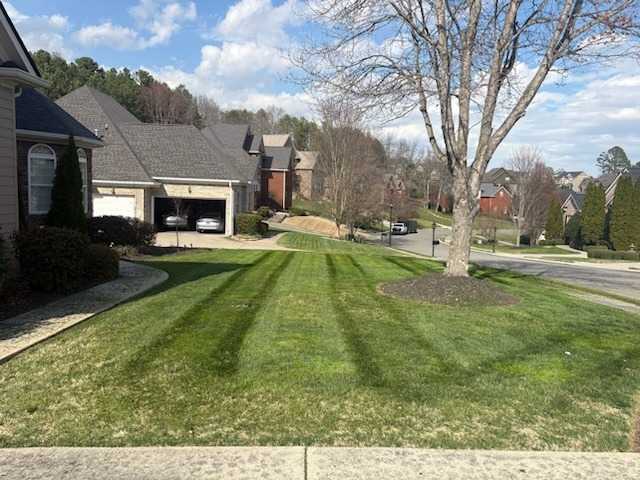
Which grass do you have?
Chattanooga sits in the turf “transition zone,” where neither warm-season nor cool-season grasses are perfectly at home. University of Tennessee Extension notes that cool-season grasses are generally preferred in East Tennessee’s Ridge and Valley region, while bermudagrass and zoysiagrass are also grown but can be injured by hard freezes. In practice you’ll see all three around town — often in the same yard, with fescue in the shade and bermudagrass in the sun.
Tall fescue
Cool-season. Green through much of the winter, grows most in spring and fall, and is often stressed in summer heat and drought.
Sun and shade: moderately shade tolerant, so it’s common under trees in established neighborhoods.
Mowing: kept taller than the warm-season grasses.
Bermudagrass
Warm-season. Grows hard in summer heat, loses color in fall and is dormant (brown) through winter, greening up again in spring.
Sun and shade: generally intolerant of shade; thins out under trees.
Mowing: cut low, and often — it spreads and grows fast in summer.
Zoysiagrass
Warm-season. A dense, sod-forming grass that, like bermudagrass, goes dormant in winter.
Sun and shade: slightly more shade tolerant than bermudagrass.
Mowing: cut low, similar to bermudagrass.
Winter color is a clue, but it won’t identify a grass on its own. Dormancy, overseeding, mixed grasses and weather can all change how a lawn looks. Include what you know about your grass when you request an estimate.
Mowing height and the one-third rule
There is no single “right” mowing height for every Chattanooga lawn. The most useful rule is about how much you cut, not a fixed number:
The one-third rule: mow when the grass is about one and a half times its target height, so no more than a third of the blade comes off at once. UT Extension’s examples: a tall fescue lawn kept at 2 inches is mowed when it reaches about 3 inches; bermudagrass or zoysiagrass kept at 1½ inches is mowed at about 2¼ inches.
Those are examples, not prescriptions. The right height for your lawn depends on the grass and variety, how much shade it gets, the season and the mower. What matters is that the height suits the grass, and that each cut is light enough not to scalp it.
- Growth sets the schedule. Weekly mowing is a common starting point during active growth. Fast growth can require more frequent cuts; heat, drought or dormancy can slow it down. Choose a schedule around the grass’s actual growth and the one-third rule.
- Sharp blades matter. UT Extension notes that leaves torn by a dull blade give fungal disease a way in. We keep our mowers maintained and cleaned regularly.
- Clippings can stay. Short clippings break down quickly and don’t add significantly to thatch, so a properly mowed lawn doesn’t need bagging. We blow clippings off drives, walks and beds.
Want this handled for you? See lawn mowing & maintenance.
A Chattanooga lawn, season by season
This is the general pattern we plan around. Your lawn may differ with its grass, shade and slope.
Late winter (February – early March)
Bermudagrass and zoysiagrass are still dormant. Fescue lawns get a first tidy-up cut in February and another as March begins. Clear leftover leaves and debris before growth starts.
Spring (mid-March – May)
Fescue grows fast and mowing becomes more frequent. Warm-season lawns green up as the weather warms. Clean out beds, but time shrub pruning to the species; spring-flowering shrubs are generally pruned after blooming.
Summer (June – August)
Bermudagrass and zoysiagrass are at their peak and need regular low cuts. Fescue is under heat stress, so it’s kept on the tall side and never scalped.
Fall (September – November)
Fescue’s second growing season. Warm-season grass slows, loses color and heads toward dormancy, so cuts space out. Falling leaves are mulched or removed so they don’t smother the lawn.
Leaves: mulch or remove?
University turf specialists note that tree leaves can be mulched into a lawn with a mower without harming it, as long as they’re chopped into pieces small enough to fall down between the grass blades. A heavy layer left sitting on the grass blocks light and can cause parts of the lawn to die back. Mulch when the layer is light; collect and remove leaves when they pile up. See leaf and seasonal cleanup.
Mowing service vs. lawn treatments
“Lawn care” covers two different kinds of work, and it helps to know which one you’re shopping for:
- Mowing and maintenance — mowing, string trimming, edging, blowing off hard surfaces, hedge and shrub trimming, bed upkeep and leaf cleanup. This is what Quality Lawn Care & Landscaping does.
- Treatments — fertilizer programs, weed control, and insect or disease control. The Tennessee Department of Agriculture requires businesses offering custom pesticide applications to hold a pest control charter, with a licensee in each category of service offered. Fertilizer without pesticides is a separate category of work; see the state’s guidance in the sources below.
Our services on this site are mowing and maintenance; we don’t list fertilization or weed-control treatments. Good mowing still helps: a lawn cut at the right height for its grass, never scalped, with sharp blades, is better placed to hold its own against weeds and stress.
Sources
- Master Gardener Handbook, Chapter 10: Turfgrass Management in Tennessee — University of Tennessee Extension. Grass adaptation in Tennessee regions, shade tolerance, the one-third rule and its examples, sharp blades, clippings.
- Keep mowing to mulch those tree leaves — Purdue University Turfgrass Science. Mulching tree leaves into the lawn with a mower (Z. Reicher, 2005).
- Do I need to remove the leaves on my lawn? — Iowa State University Extension and Outreach. Why a heavy leaf layer harms turf; collecting vs. chopping leaves small enough to fall between grass blades.
- Certification, Licensing and Charters — Tennessee Department of Agriculture. Charter and licensing requirements for pest control businesses, including the Lawn and Turf category.
General guidance for Chattanooga-area home lawns. Your lawn may need something different — we’ll look at it before recommending a plan.